Ortho-K
What if you could correct your nearsightedness while you sleep and see clearly all day without glasses or contact lenses? That's exactly what Ortho-K does. Also known as orthokeratology or corneal refractive therapy, Ortho-K uses custom-designed lenses worn overnight to gently and temporarily reshape the front surface of your eye. You take them out in the morning and go about your day with clear, unaided vision.
Dr. Gallo & Associates is now offering Ortho-K at our Maple location in Vaughan. It's a non-surgical, fully reversible option for adults who want freedom from daytime lenses - and one of the most effective tools available for slowing the progression of myopia in children.

What is Ortho-K?
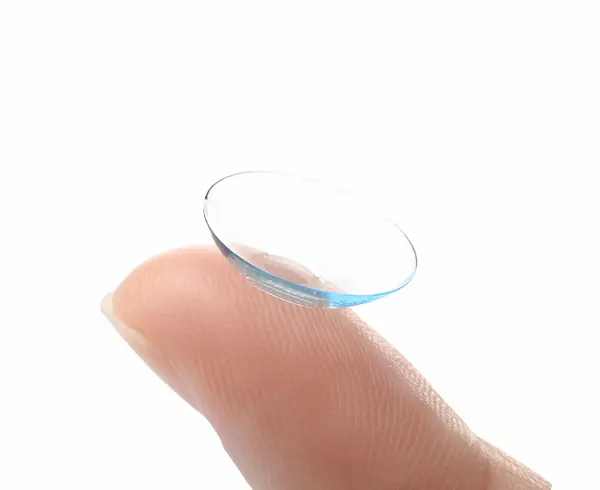
Ortho-K is short for orthokeratology. It uses custom-made rigid gas-permeable lenses that you wear only while you sleep. These lenses apply gentle, controlled pressure to the cornea — the clear dome at the front of the eye that provides roughly 75% of your eye's focusing power. Overnight, the cornea reshapes just enough to bring light into proper focus on the retina.
Think of them as retainers for your eyes. Where dental braces reposition teeth, Ortho-K lenses reposition the focus of your eye. The effect is temporary: stop wearing the lenses and your corneas gradually return to their original shape within days. That reversibility is one of the biggest advantages over laser surgery, which permanently removes corneal tissue.
Most people reach the full effect after about one week of consistent overnight wear.
Ortho-K
Helping Kids See Better

Is Ortho-K Right for You or Your Child?
Ortho-K is most commonly used to correct myopia, but it can also address astigmatism and, in some designs, hyperopia and presbyopia. As a general guide, it works best for prescriptions up to about -4.50D with up to -1.50D of astigmatism. Stronger prescriptions can often still be treated with partial correction, though results vary.Ortho-K may be a good fit if you or your child:
- Are nearsighted and want to be glasses-free during the day
- Play sports, swim, or work in dusty or physically demanding environments
- Are a child or teen whose prescription is increasing each year
- Find soft contact lenses dry or uncomfortable by the end of the day
- Want a reversible alternative to LASIK, or aren't a surgical candidate
The youngest patients are typically fitted around age six or seven — the real deciding factor is maturity and willingness to follow the care routine, not a number. There's no upper age limit as long as your eye health and prescription are suitable.
The only way to know for certain is a suitability assessment, where we measure your prescription and map the surface of your cornea.

Ortho-K for Myopia Control in Children
Myopia is rising sharply among Canadian children, and it usually worsens year over year through the school years. This matters beyond thicker glasses: higher myopia in adulthood carries increased lifetime risk of retinal detachment, glaucoma, myopic maculopathy, and early cataract.Ortho-K is one of the most well-researched myopia control options available. Studies consistently show it slows the progression of myopia in children by roughly half compared with standard single-vision glasses or contact lenses.
Parents often appreciate a second benefit: all the lens handling and cleaning happens at home, under supervision, rather than at school or on the soccer field. Kids get clear vision for sports, swimming, dance, and screen time without glasses in the way.
We've built Ortho-K into our broader myopia control program, so we can talk you through how it compares to myopia control soft lenses, specialty spectacle lenses, and low-dose atropine drops, and recommend what fits your child best.

Is Ortho-K Safe?
Yes, when the lenses are properly fitted, cared for, and monitored. Research shows the risk of eye infection with Ortho-K is very low and comparable to that of reusable daytime soft contact lenses. Ortho-K lenses are made from highly oxygen-permeable material specifically designed for overnight wear, and because they're removed and disinfected every morning, there's far less opportunity for problems to develop than with soft lenses slept in for days at a time.
The most important safety rule is simple: never let tap water touch your lenses, your case, or your hands right before handling lenses. Water can carry microorganisms such as Acanthamoeba, which can cause a serious corneal infection. We'll walk you and your child through the complete care routine, and keeping your scheduled follow-up appointments is part of what makes Ortho-K safe.
How Ortho-K Works While You Sleep
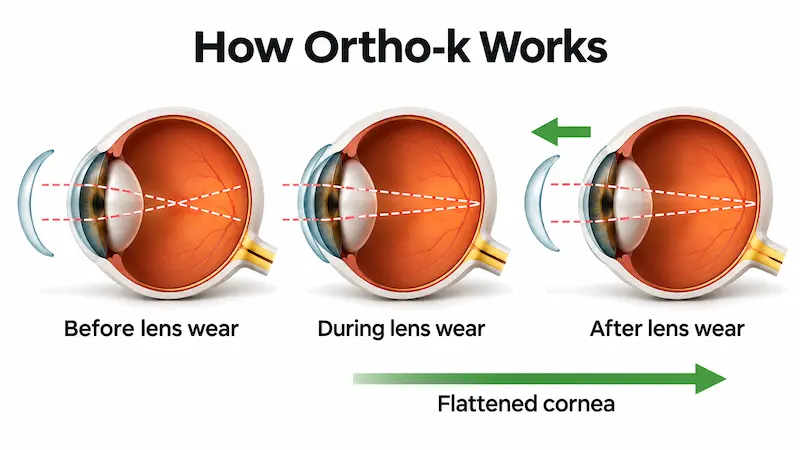
Nearsightedness happens when the eye has too much focusing power, so light lands in front of the retina instead of on it. Flattening the central cornea very slightly reduces that focusing power and brings the image back into sharp focus.
When you sleep in Ortho-K lenses, the pressure of your closed eyelids and the fluid dynamics of your tear film hold the lens in place and guide the cornea into its new shape. In the morning, you remove and clean the lenses — and your vision stays clear through the day.
Because the lenses are worn in a closed-eye environment, many patients find them surprisingly comfortable. There's no lens drying out at your desk, no lens popping out mid-game, and no fogged-up glasses walking into a warm building from a Vaughan winter.